 -by
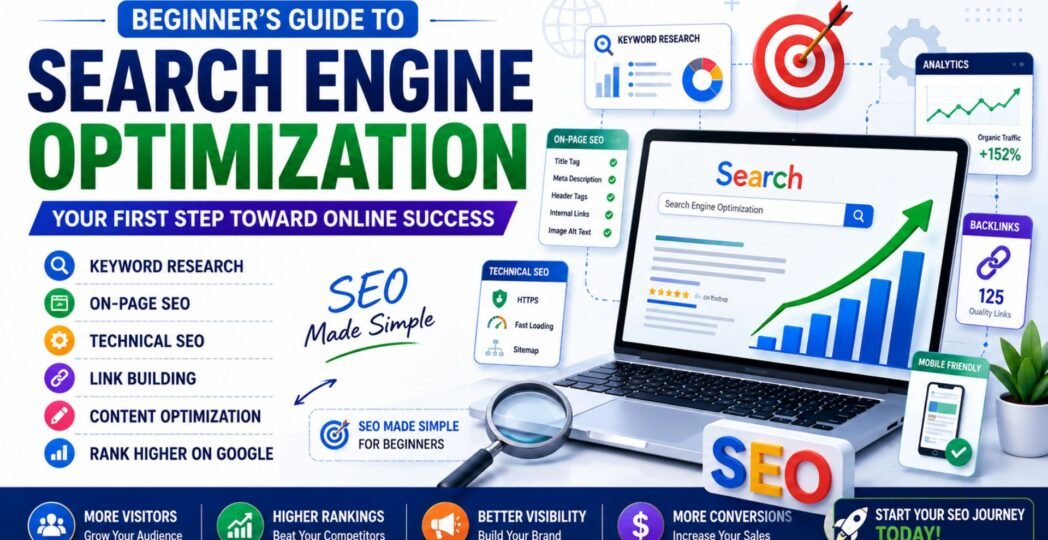
-by Imagine you’ve just opened a beautiful little shop in the middle of a busy city. You have great products, a welcoming atmosphere, and excellent customer service. However, there’s one problem—no one knows your shop exists. A website without search engine optimization is surprisingly similar.
When I first launched my own website, I expected visitors to arrive automatically. Instead, the traffic stayed close to zero for weeks. That experience taught me one valuable lesson: creating great content is only the beginning. You also need to help search engines understand and recommend your website.
So, if you’re just starting your digital journey, this beginner’s guide will help you understand search engine optimization (SEO) in a simple and practical way.
What Is Search Engine Optimization?
Search engine optimization (SEO) is the process of improving your website so that search engines like Google can understand, rank, and display it to people searching for relevant information.
Think of search engine optimization (SEO) as creating a clear road map. Without it, search engines may struggle to find your content. With proper optimization, your pages become easier to discover. Moreover, search engine optimization (SEO) is not about tricking search engines. Instead, it focuses on creating valuable content and providing an excellent experience for real users.
Why Is Search Engine Optimization Important?
Have you ever searched for something online and clicked on one of the first few results? Most people do exactly that. Therefore, websites that appear on the first page receive significantly more visitors than those buried deeper in the search results.
Better visibility often leads to more traffic, stronger brand awareness, and higher sales. In addition, search engine optimization (SEO) provides long-term benefits. Unlike paid advertising, organic traffic can continue growing even after your content has been published.
How Search Engines Work
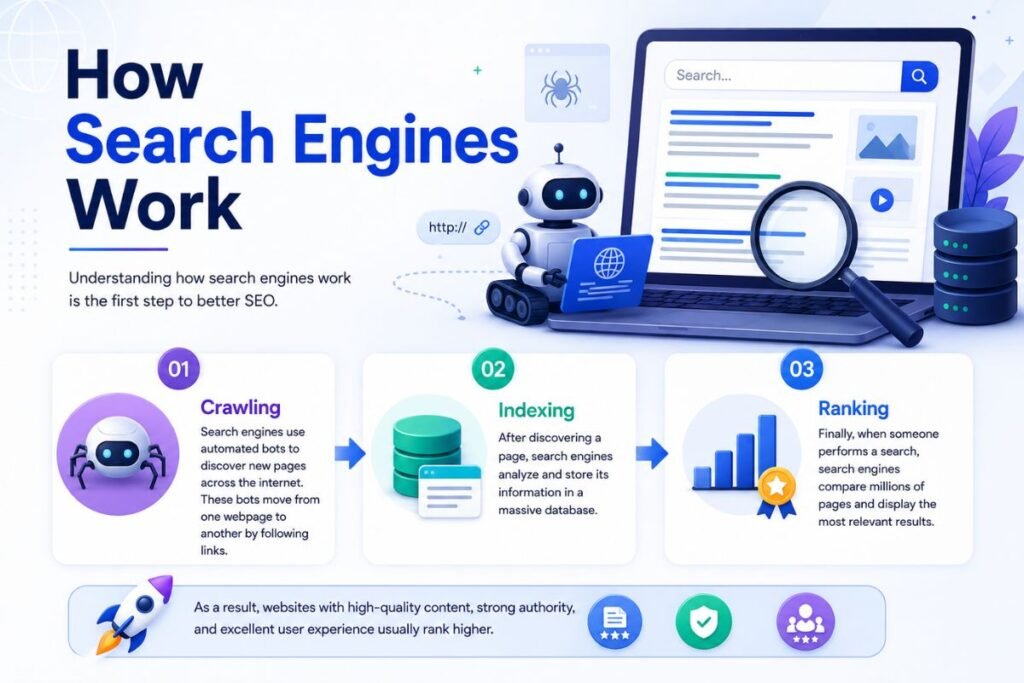
Before learning search engine optimization (SEO) strategies, it’s helpful to understand how search engines operate.
Crawling
Search engines use automated bots to discover new pages across the internet. These bots move from one webpage to another by following links.
Indexing
After discovering a page, search engines analyze and store its information in a massive database.
Ranking
Finally, when someone performs a search, search engines compare millions of pages and display the most relevant results.
As a result, websites with high-quality content, strong authority, and excellent user experience usually rank higher.
Keyword Research: The Foundation of SEO
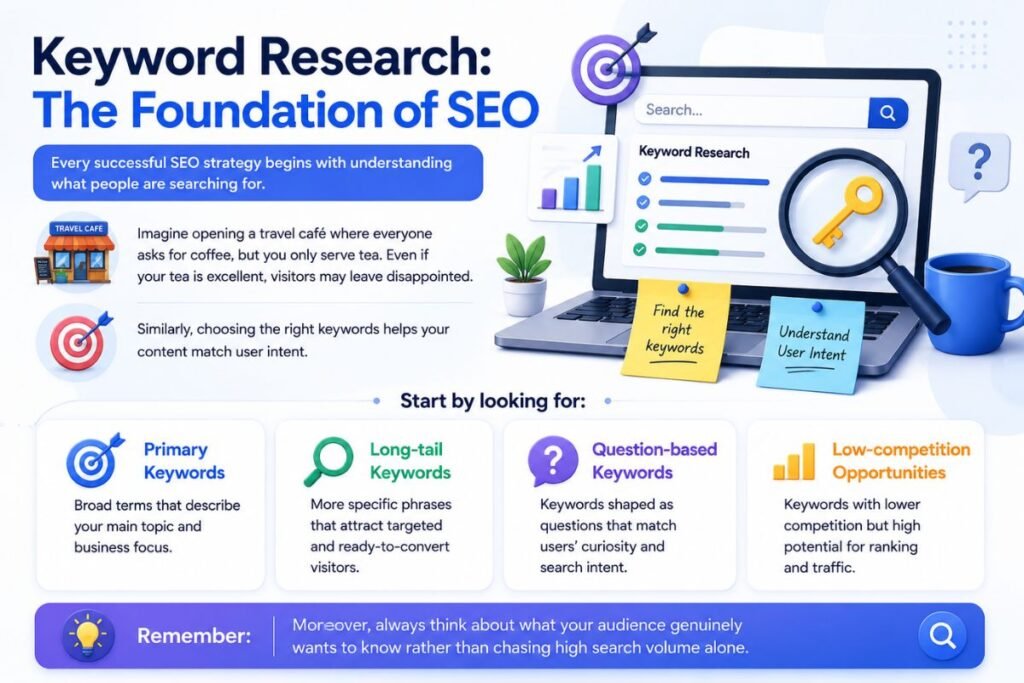
Every successful search engine optimization (SEO) strategy begins with understanding what people are searching for.
Imagine opening a travel café where everyone asks for coffee, but you only serve tea. Even if your tea is excellent, visitors may leave disappointed.
Similarly, choosing the right keywords helps your content match user intent.
Start by looking for:
- Primary keywords
- Long-tail keywords
- Question-based keywords
- Low-competition opportunities
Moreover, always think about what your audience genuinely wants to know rather than chasing high search volume alone.
Create High-Quality Content
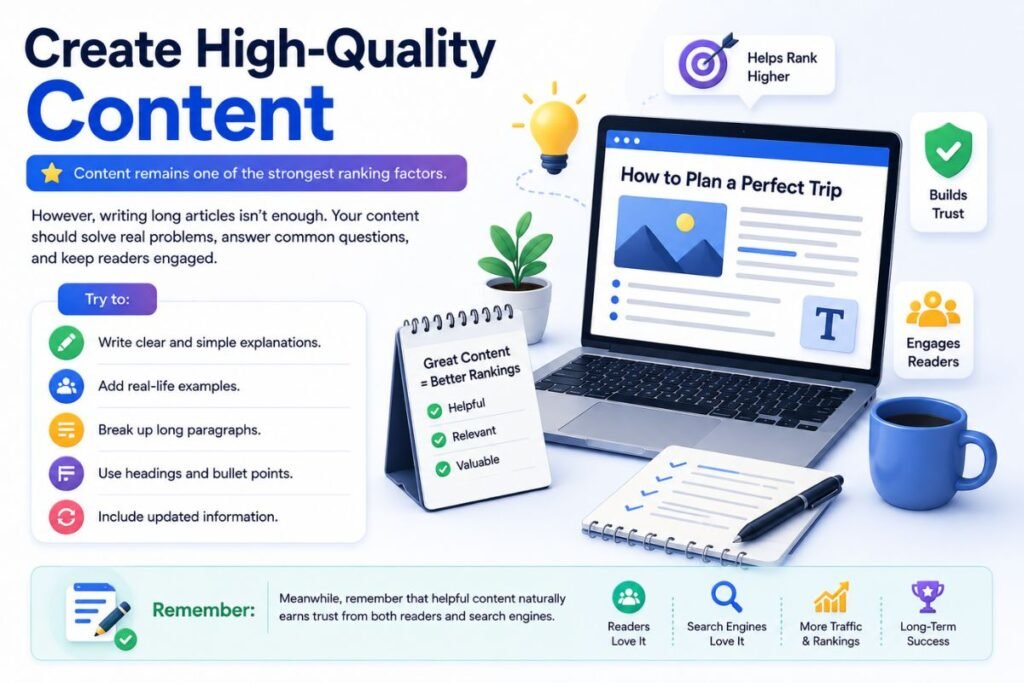
Content remains one of the strongest ranking factors. However, writing long articles isn’t enough. Your content should solve real problems, answer common questions, and keep readers engaged.
Try to:
- Write clear and simple explanations.
- Add real-life examples.
- Break up long paragraphs.
- Use headings and bullet points.
- Include updated information.
Meanwhile, remember that helpful content naturally earns trust from both readers and search engines.
Want to create high-quality articles faster? Explore our guide to the best free AI content creation tools and streamline your writing process.
Optimize Your On-Page SEO
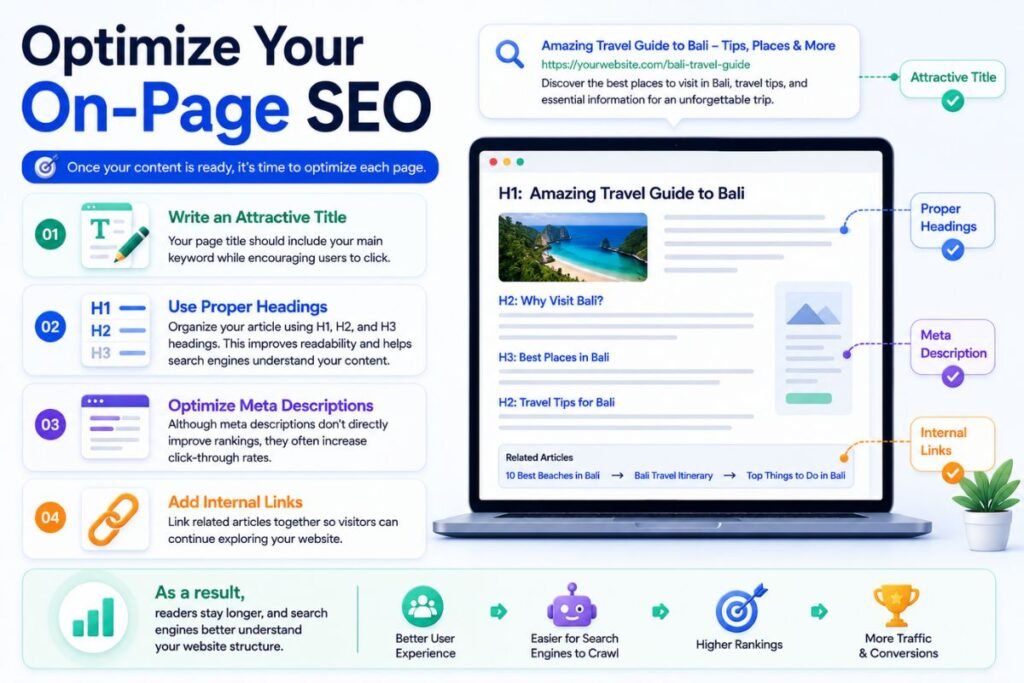
Once your content is ready, it’s time to optimize each page.
Write an Attractive Title
Your page title should include your main keyword while encouraging users to click.
Use Proper Headings
Organize your article using H1, H2, and H3 headings. This improves readability and helps search engines understand your content.
Optimize Meta Descriptions
Although meta descriptions don’t directly improve rankings, they often increase click-through rates.
Add Internal Links
Link related articles together so visitors can continue exploring your website. As a result, readers stay longer, and search engines better understand your website structure.
Optimize Your Off-Page SEO
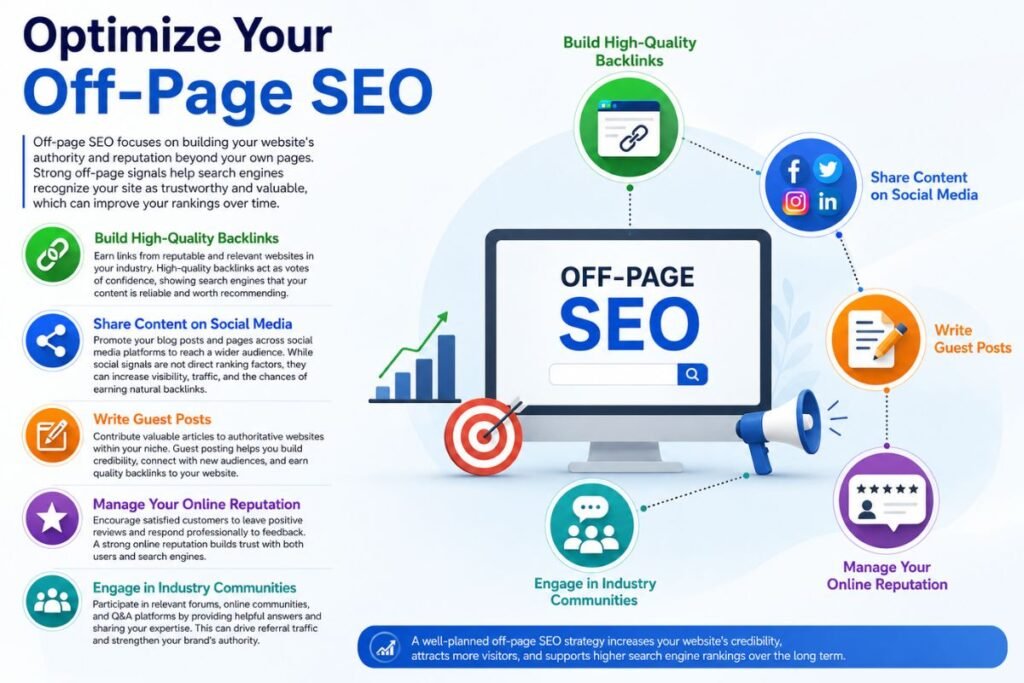
Off-page SEO focuses on building your website’s authority and reputation beyond your own pages. Strong off-page signals help search engines recognize your site as trustworthy and valuable, which can improve your rankings over time.
Build High-Quality Backlinks
Earn links from reputable and relevant websites in your industry. High-quality backlinks act as votes of confidence, showing search engines that your content is reliable and worth recommending.
Share Content on Social Media
Promote your blog posts and pages across social media platforms to reach a wider audience. While social signals are not direct ranking factors, they can increase visibility, traffic, and the chances of earning natural backlinks.
Write Guest Posts
Contribute valuable articles to authoritative websites within your niche. Guest posting helps you build credibility, connect with new audiences, and earn quality backlinks to your website.
Manage Your Online Reputation
Encourage satisfied customers to leave positive reviews and respond professionally to feedback. A strong online reputation builds trust with both users and search engines.
Engage in Industry Communities
Participate in relevant forums, online communities, and Q&A platforms by providing helpful answers and sharing your expertise. This can drive referral traffic and strengthen your brand’s authority.
As a result, a well-planned off-page SEO strategy increases your website’s credibility, attracts more visitors, and supports higher search engine rankings over the long term.
Improve Website Speed
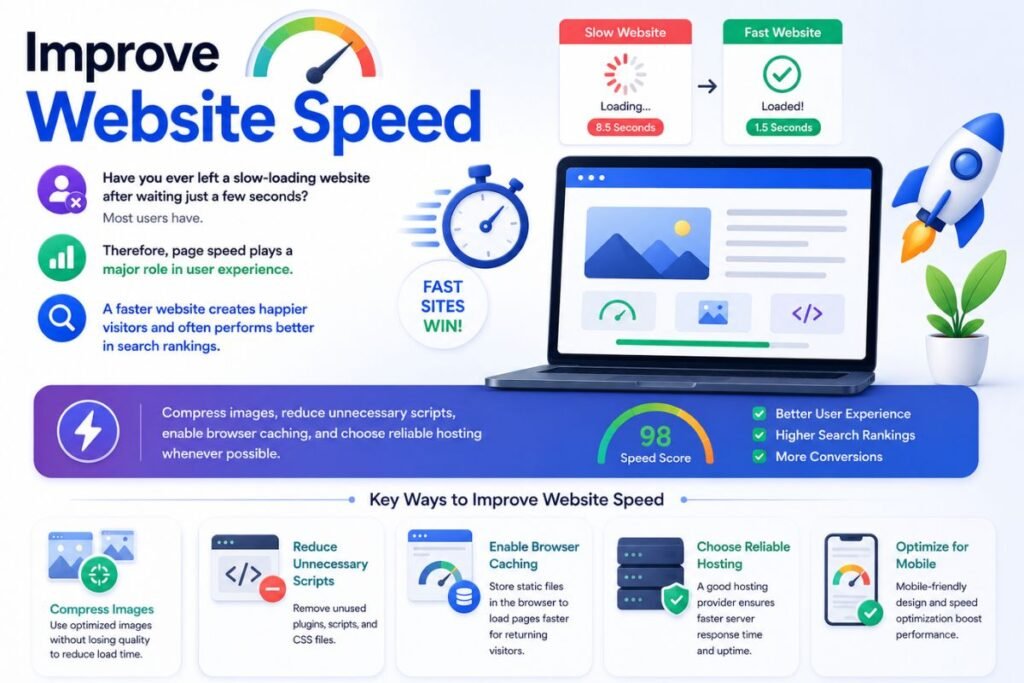
Have you ever left a slow-loading website after waiting just a few seconds? Most users have. Therefore, page speed plays a major role in user experience.
Compress images, reduce unnecessary scripts, enable browser caching, and choose reliable hosting whenever possible. A faster website creates happier visitors and often performs better in search rankings.
Make Your Website Mobile-Friendly
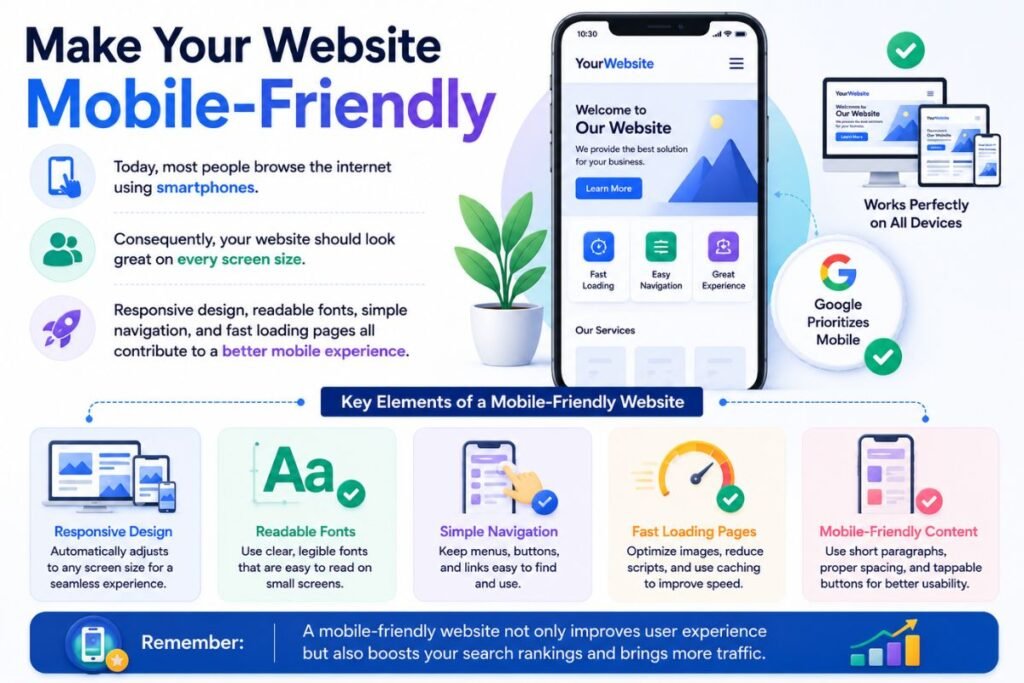
Today, most people browse the internet using smartphones. Consequently, your website should look great on every screen size.
Responsive design, readable fonts, simple navigation, and fast-loading pages all contribute to a better mobile experience. Moreover, Google primarily evaluates the mobile version of many websites when determining rankings.
Build High-Quality Backlinks
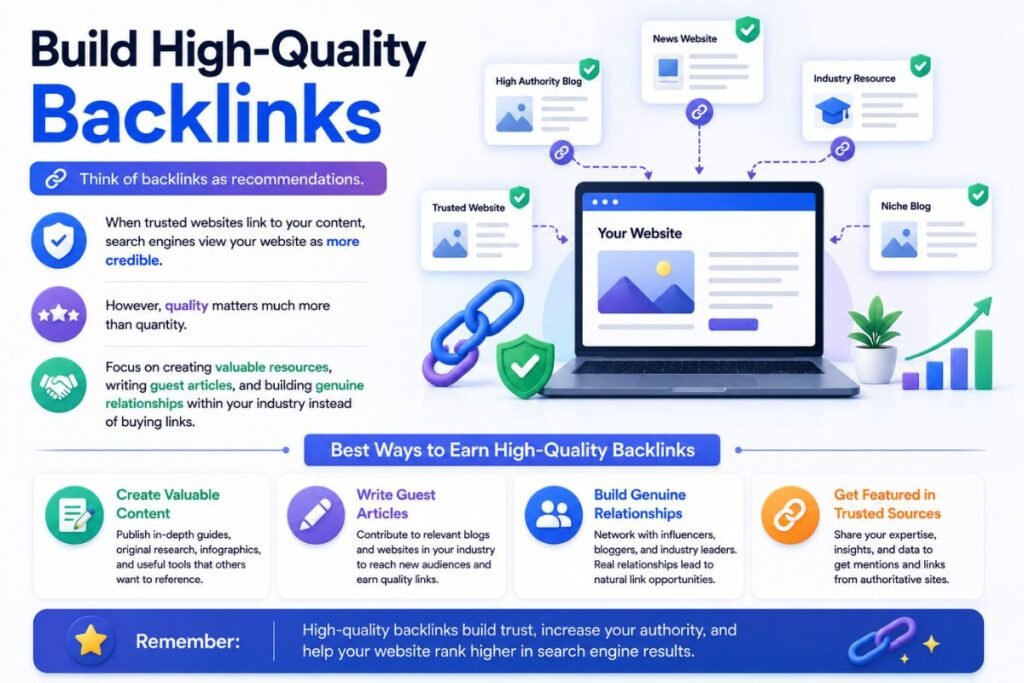
Think of backlinks as recommendations. When trusted websites link to your content, search engines view your website as more credible.
However, quality matters much more than quantity. Focus on creating valuable resources, writing guest articles, and building genuine relationships within your industry instead of buying links.
Understand Technical SEO
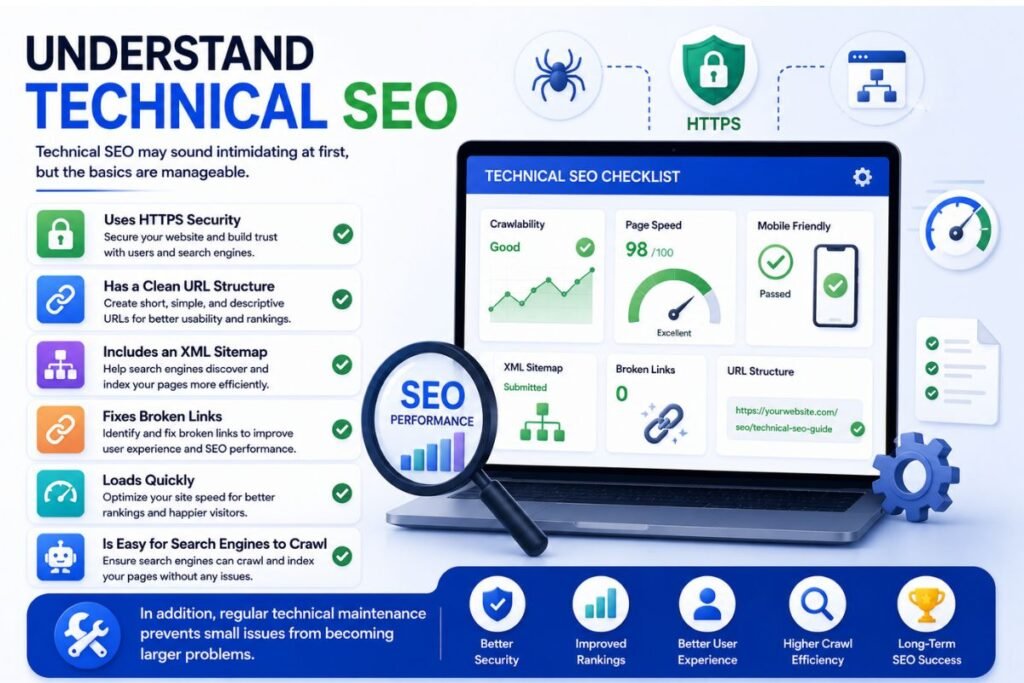
Technical SEO may sound intimidating at first, but the basics are manageable.
Make sure your website:
- Uses HTTPS security
- Has a clean URL structure
- Includes an XML sitemap
- Fixes broken links
- Loads quickly
- Is easy for search engines to crawl
In addition, regular technical maintenance prevents small issues from becoming larger problems.
Measure Your SEO Performance
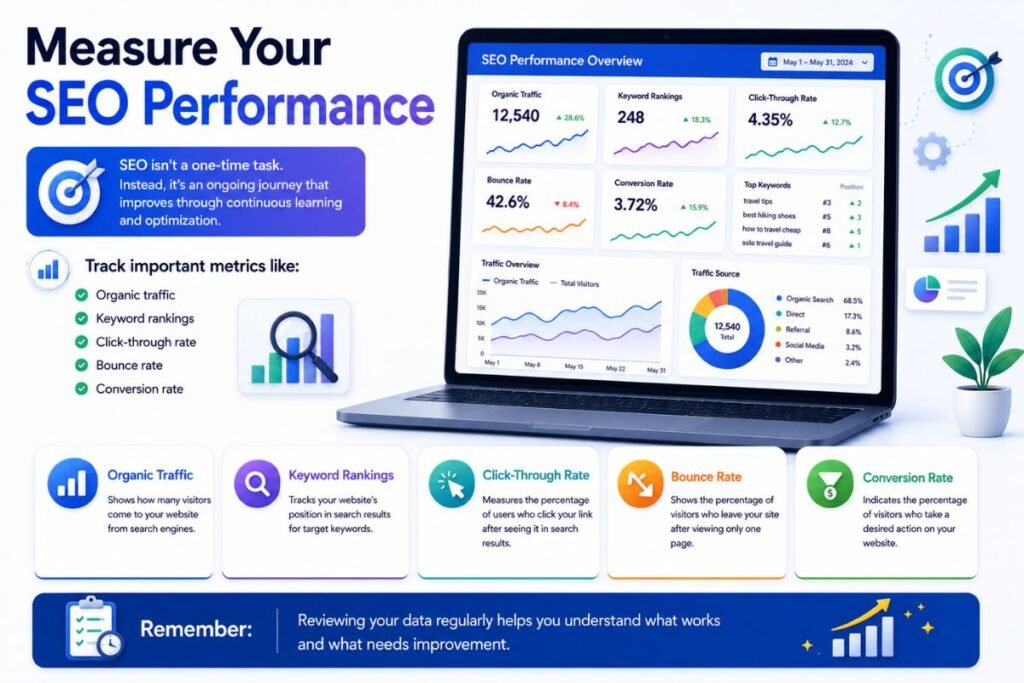
SEO isn’t a one-time task. Instead, it’s an ongoing journey that improves through continuous learning and optimization.
Track important metrics like:
- Organic traffic
- Keyword rankings
- Click-through rate
- Bounce rate
- Conversion rate
Meanwhile, reviewing your data regularly helps you understand what works and what needs improvement.
Want to learn how live stream shopping is transforming online retail? Explore our comprehensive guide to discover the latest trends, benefits, and best practices.
Common SEO Mistakes Beginners Should Avoid
Every beginner makes mistakes, and that’s completely normal.
However, avoiding these common errors can save considerable time.
- Keyword stuffing
- Publishing thin content
- Ignoring mobile users
- Forgetting internal links
- Using duplicate content
- Neglecting page speed
- Expecting instant rankings
Remember, SEO rewards patience and consistency far more than shortcuts.
Practical SEO Tips for Beginners
If you’re wondering where to begin today, keep it simple. Choose one keyword for each article. Write genuinely helpful content. Improve user experience. Update older posts regularly. Build internal links naturally.
Moreover, keep learning because search engine optimization continues evolving every year. Small improvements made consistently often produce remarkable long-term results.
Conclusion
Learning search engine optimization may seem overwhelming in the beginning, but every expert once started exactly where you are today. Instead of chasing quick wins, focus on helping your audience. Create useful content, improve your website step by step, and stay patient throughout the process.
Eventually, you’ll notice more visitors, stronger search rankings, and greater confidence in your digital journey. So, are you ready to take your first step into the world of SEO? Your website’s success story could begin with the very next article you publish.
Frequently Asked Questions
Q01. What is search engine optimization (SEO)?
Ans: Search engine optimization (SEO) is the process of improving a website so it appears higher in search engine results like Google. It involves creating valuable content, optimizing web pages, improving website performance, and earning quality backlinks to attract more organic traffic.
Q02. Why is search engine optimization important for beginners?
Ans: Search engine optimization is important because it helps beginners increase their website’s visibility without spending money on advertisements. A well-optimized website can attract more visitors, build trust, and generate long-term organic traffic.
Q03. How long does SEO take to show results?
Ans: SEO is a long-term strategy, and results usually take between three and six months. However, the timeline depends on your competition, website authority, content quality, and how consistently you optimize your site.
Q04. Can I learn search engine optimization without any technical experience?
Ans: Yes. Anyone can learn the basics of search engine optimization. You can start by understanding keyword research, creating helpful content, improving page titles, and learning basic on-page SEO before moving on to more advanced techniques.
Q05. What are the three main types of SEO?
Ans: The three primary types of SEO are:
- On-Page SEO: Optimizing content, titles, headings, images, and internal links.
- Off-Page SEO: Building backlinks and increasing website authority.
- Technical SEO: Improving website speed, security, mobile responsiveness, and crawlability.
Q06. What is keyword research in SEO?
Ans: Keyword research is the process of finding the words and phrases people use when searching online. Choosing the right keywords helps you create content that matches user intent and improves your chances of ranking higher in search results.
Q07. Is SEO better than paid advertising?
Ans: SEO and paid advertising serve different purposes. SEO provides long-term, sustainable organic traffic, while paid advertising delivers immediate visibility. Many successful businesses use both strategies together for the best results.
Q08. How often should I update my website for better SEO?
Ans: It’s a good idea to review and update important pages every few months. Refreshing outdated information, adding new insights, improving internal links, and updating statistics can help maintain or improve your search rankings.
Q09. What are the most common SEO mistakes beginners make?
Ans: Some common mistakes include keyword stuffing, publishing low-quality content, ignoring mobile optimization, neglecting page speed, using duplicate content, forgetting internal links, and expecting instant ranking improvements.
Q10. Do backlinks still matter in search engine optimization?
Ans: Yes. High-quality backlinks remain an important ranking factor because they signal trust and authority to search engines. However, it’s better to earn links naturally from reputable websites than to buy or manipulate backlinks.
Q11. What tools should beginners use for SEO?
Ans: Beginners can start with tools like Google Search Console, Google Analytics, Google Keyword Planner, Rank Math, and Google Trends. As you gain experience, you can also explore advanced SEO tools such as Ahrefs, Semrush, or Moz.
Q12. What is the first step to learning search engine optimization?
Ans: The first step is understanding how search engines work. After that, learn keyword research, create helpful content, optimize your pages, improve website performance, and monitor your results regularly. Consistent learning and practice are the keys to long-term SEO success.





8 Comments