 -by
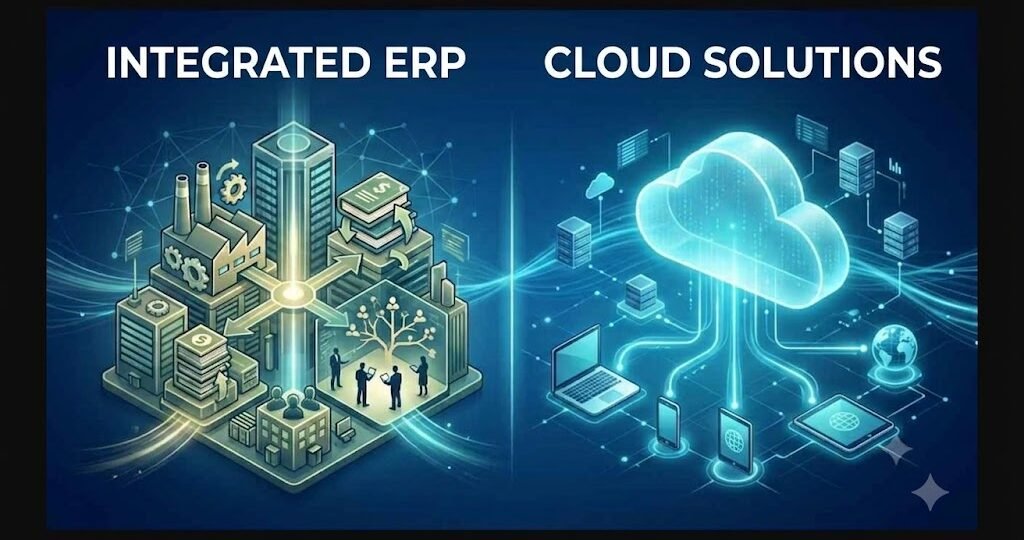
-by Businesses around the world are embracing digital transformation to improve efficiency, reduce operational costs, and stay competitive. One of the biggest drivers of this transformation is ERP and Cloud Computing. Organizations of all sizes now rely on cloud-powered enterprise systems to manage finance, human resources, supply chains, customer relationships, manufacturing, and business analytics from a single platform.
The combination of ERP and Cloud Computing has changed how companies store, access, and analyze information. Instead of relying on expensive on-premises servers, businesses can use secure cloud infrastructure to run critical operations anytime and anywhere.
Whether you own a startup, manage a growing company, or work in a global enterprise, understanding ERP and Cloud Computing can help you make smarter technology decisions. This guide explains everything in simple language, including what is ERP, what is cloud computing, key benefits, implementation strategies, emerging trends, and the future of cloud-based enterprise software.
For more technology insights and digital transformation guides, visit Tech All World and Techh AtoZ. Businesses in hospitality and tourism can also explore Restaurent and Beach Near for industry-specific resources and travel-related business ideas.
What Is ERP?
Before exploring ERP and Cloud Computing, it is important to understand what is ERP. ERP stands for Enterprise Resource Planning. If someone asks, what does ERP stand for, the answer is Enterprise Resource Planning—a software solution that integrates different business processes into one centralized system.
An ERP system helps organizations manage daily operations, including:
- Finance and accounting
- Human resources
- Payroll
- Procurement
- Inventory
- Manufacturing
- Sales
- Customer service
- Supply chain management
- Reporting and analytics
Instead of using multiple disconnected applications, an ERP software platform stores business information in one shared database. This improves collaboration, reduces duplicate work, and provides accurate real-time insights.
Looking to stay updated with the fast-changing tech world? Read more about our Cloud Gaming and all kinds of tech news, blogs & reviews.
What Is an ERP System?
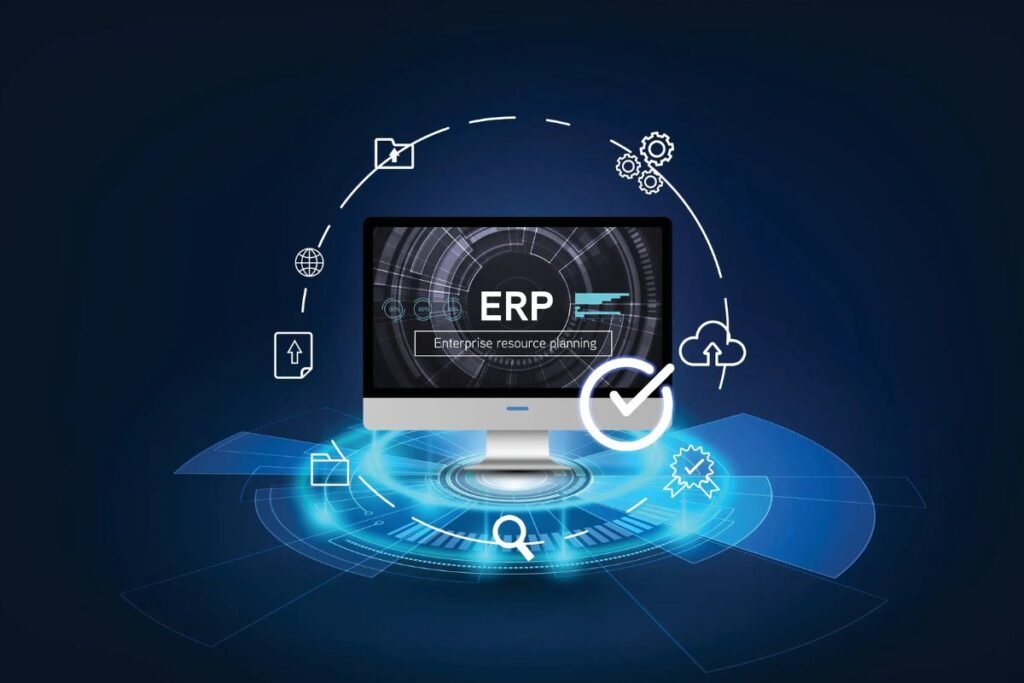
If you are wondering what is an ERP system, think of it as the digital backbone of a business.
An ERP platform connects departments so everyone works with the same data. For example:
- Sales teams update customer orders.
- Inventory managers instantly see stock changes.
- Finance departments receive automatic billing information.
- Executives access live business dashboards.
This integration eliminates manual data entry and improves decision-making.
ERP System Meaning
The ERP system meaning goes beyond software. It represents a complete business management approach that brings people, processes, and technology together.
Modern organizations depend on ERP solutions because they:
- Increase productivity
- Improve operational efficiency
- Reduce costs
- Strengthen compliance
- Enhance customer satisfaction
- Support business growth
What Is Cloud Computing?
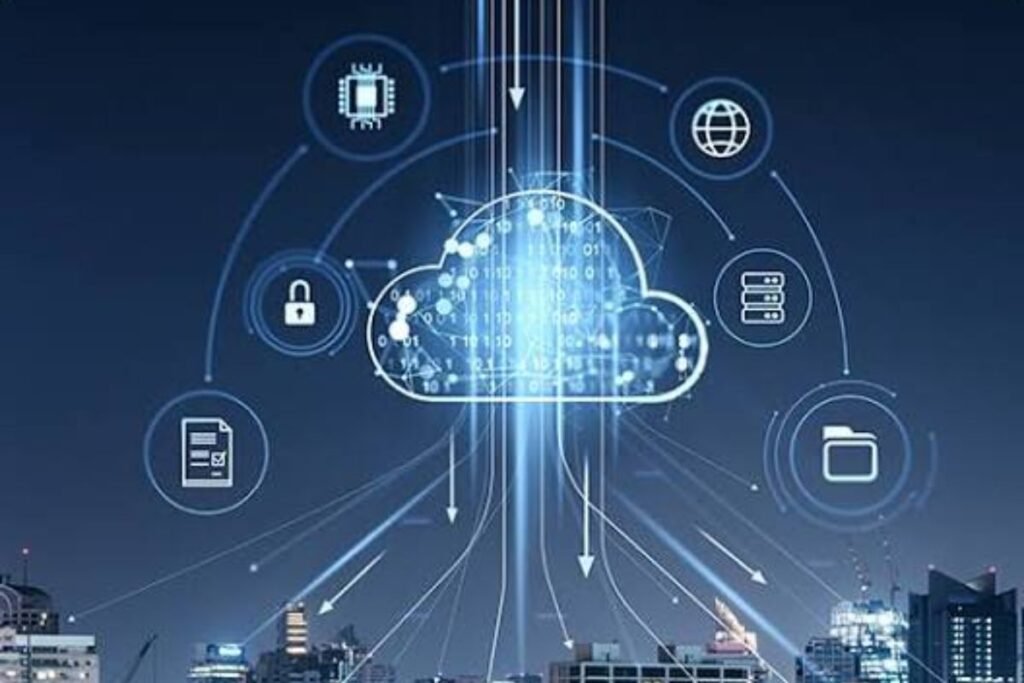
Understanding what is cloud computing and this is equally important. Cloud computing is the delivery of computing resources over the internet. Instead of owning physical servers and data centers, businesses access computing power from cloud providers whenever they need it.
These resources include:
- Servers
- Storage
- Databases
- Networking
- Artificial intelligence
- Software applications
- Analytics
- Security services
Simply put, cloud computing explained means using internet-based technology instead of local hardware. Today, cloud computing services allow businesses to operate securely without maintaining expensive infrastructure.
Organizations that rely on cloud-based infrastructure for remote collaboration and digital operations should also ensure their hardware performs efficiently. If you’re planning to stream resource-intensive applications or live content, check out our guide on how to optimize a gaming PC for streaming for practical performance optimization tips.
Cloud Computing Explained
To understand cloud computing explained, imagine storing important business documents. Instead of saving files on one office computer, you store them securely in the cloud. Employees can access them from any authorized device, whether they are in New York, London, Tokyo, or Sydney. The same concept applies to business software.
Instead of installing an ERP application on local servers, companies can use cloud ERP, where the software runs in secure cloud data centers managed by the provider. This approach offers greater flexibility, automatic updates, and lower maintenance costs.
How ERP and Cloud Computing Work Together
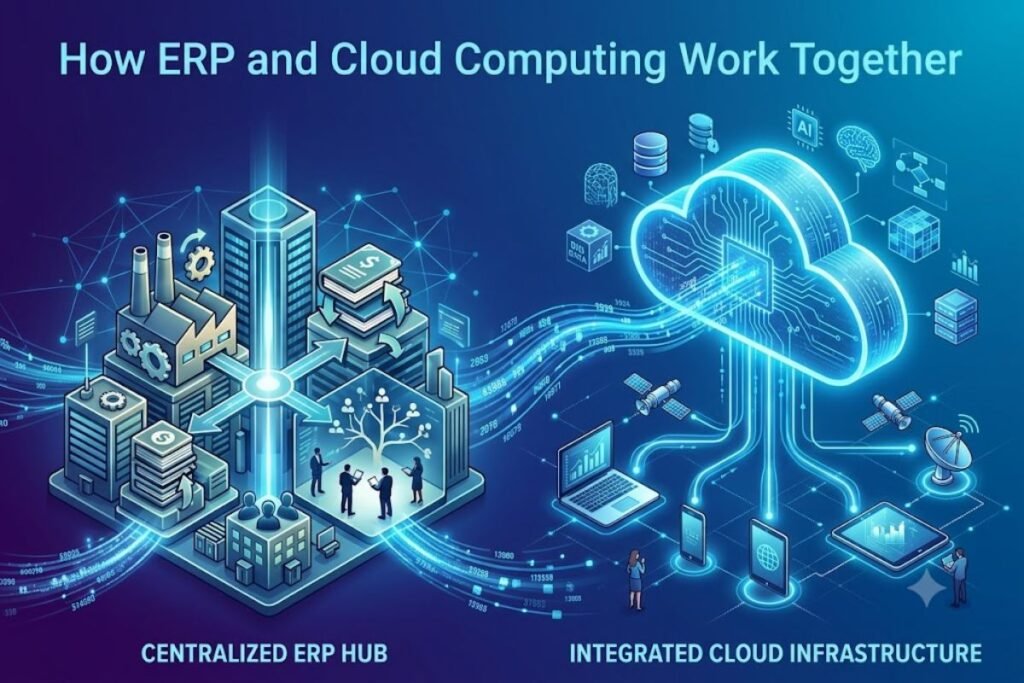
The combination of ERP and Cloud Computing creates a modern business platform that is accessible from anywhere with an internet connection.
Traditional ERP systems required companies to purchase:
- Physical servers
- Networking equipment
- Database licenses
- Security infrastructure
- IT maintenance services
Cloud ERP removes many of these requirements.
Instead, businesses subscribe to cloud-based ERP software that includes:
- Automatic updates
- Data backups
- Disaster recovery
- Security monitoring
- Remote accessibility
- Scalable infrastructure
As a result, organizations can focus more on business growth rather than managing IT systems.
Difference Between ERP and Cloud Computing
Many people confuse these two concepts. Understanding the difference between ERP and cloud computing helps businesses choose the right technology strategy.
| ERP | Cloud Computing |
| Business management software | Internet-based computing platform |
| Manages business processes | Provides computing infrastructure |
| Focuses on operations | Focuses on technology delivery |
| Integrates departments | Hosts applications and services |
| Can be cloud-based or on-premises | Supports thousands of different applications |
In simple terms:
- ERP software manages your business.
- Cloud computing delivers the technology that runs your business applications.
Together, they create flexible, scalable enterprise solutions.
Why Businesses Are Moving to Cloud ERP
Companies across industries are rapidly adopting cloud ERP because it provides significant advantages over traditional systems.
The main reasons include:
Lower Initial Investment
Organizations avoid purchasing expensive servers and networking equipment.
Faster Deployment
Cloud ERP systems can often be implemented much faster than on-premises solutions.
Better Accessibility
Employees can securely access business systems from offices, homes, or while traveling.
Automatic Updates
Software providers regularly deliver new features, performance improvements, and security patches without disrupting operations.
Improved Collaboration
Departments share real-time information, reducing communication gaps and improving productivity.
Key Components of an ERP System
A modern ERP system typically includes several integrated modules.
Finance and Accounting
This module manages:
- General ledger
- Accounts payable
- Accounts receivable
- Budgeting
- Financial reporting
- Tax compliance
Human Resources
HR modules support:
- Employee records
- Payroll
- Recruitment
- Performance management
- Attendance
- Benefits administration
Inventory Management
Businesses can monitor:
- Stock levels
- Warehouse operations
- Product movement
- Purchase orders
- Supplier management
Sales and Customer Management
These features help organizations:
- Track customer orders
- Generate invoices
- Monitor sales performance
- Improve customer relationships
Supply Chain Management
Supply chain modules optimize:
- Procurement
- Logistics
- Vendor relationships
- Production planning
- Delivery scheduling
Types of Cloud Computing Services
Understanding cloud computing services helps businesses choose the right deployment model.
Infrastructure as a Service (IaaS)
IaaS provides virtual servers, storage, and networking over the internet. Examples include hosting business applications without purchasing physical hardware.
Platform as a Service (PaaS)
PaaS offers developers a complete environment for building, testing, and deploying applications.
Software as a Service (SaaS)
SaaS delivers software through a web browser. Most cloud ERP solutions are SaaS applications, allowing businesses to use enterprise software without installing it locally.
Benefits of Cloud Computing for ERP
The benefits of cloud computing become even more valuable when combined with ERP software.
Organizations gain advantages such as:
- Lower infrastructure costs
- Faster implementation
- Better scalability
- Global accessibility
- Automatic software updates
- Improved disaster recovery
- Enhanced collaboration
- Real-time reporting
- Business continuity
- Reduced IT maintenance
These benefits enable companies to remain agile in rapidly changing markets while supporting long-term growth.
Benefits of ERP and Cloud Computing for Modern Businesses
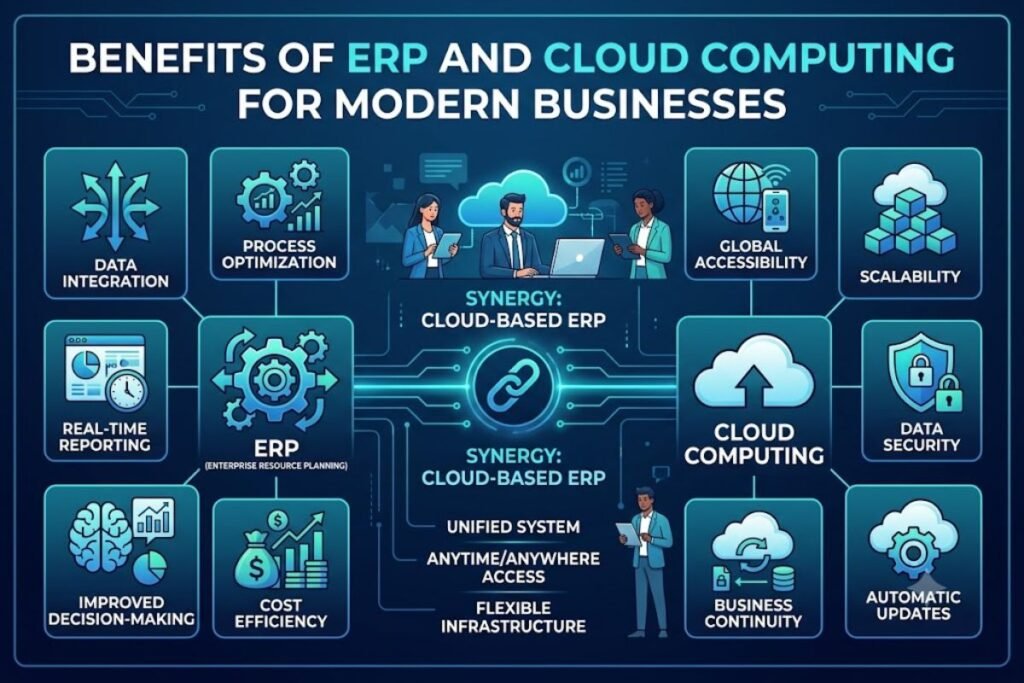
The adoption of ERP and Cloud Computing has become a strategic priority for organizations that want to improve efficiency, reduce costs, and make faster business decisions. Instead of managing separate software for finance, inventory, sales, human resources, and customer service, businesses can use one integrated platform that stores information in real time.
When companies combine an ERP system with cloud computing, they gain flexibility, scalability, and access to advanced technologies without maintaining expensive infrastructure. Below are the most important advantages.
Improved Operational Efficiency
A modern ERP software solution automates repetitive business tasks that previously required manual work.
Examples include:
- Invoice generation
- Payroll processing
- Inventory tracking
- Purchase order management
- Financial reporting
- Employee record updates
Automation reduces errors while allowing employees to focus on more valuable work.
Real-Time Business Insights
One of the biggest advantages of ERP and Cloud Computing is access to live business data. Executives no longer need to wait for weekly or monthly reports.
Instead, they can monitor:
- Revenue
- Expenses
- Inventory levels
- Sales performance
- Customer demand
- Cash flow
- Production status
Real-time dashboards help businesses respond quickly to changing market conditions.
Greater Scalability
Business growth often creates new technology challenges. Traditional systems require additional servers and hardware whenever operations expand. Cloud ERP makes scaling much easier.
Organizations can:
- Add new users
- Expand storage
- Launch new business locations
- Support international operations
- Integrate additional applications
without investing heavily in physical infrastructure.
Better Remote Accessibility
Today’s workforce is more mobile than ever. Because cloud computing technology operates over the internet, authorized users can securely access ERP software from:
- Offices
- Homes
- Airports
- Hotels
- Client locations
This flexibility supports remote work, hybrid workplaces, and international business operations.
Lower IT Costs
Maintaining traditional servers requires:
- Hardware purchases
- Data center space
- Cooling systems
- Security equipment
- Dedicated IT staff
- Software maintenance
Cloud ERP providers manage these responsibilities, allowing businesses to reduce operating expenses significantly.
Core Features of Modern ERP Software
Today’s ERP software offers much more than accounting. Leading ERP platforms include intelligent business tools that connect every department into one digital ecosystem.
Financial Management
Finance remains the foundation of every ERP solution.
Capabilities include:
- Budget planning
- Expense management
- Tax reporting
- Cash flow monitoring
- Profit analysis
- Financial forecasting
Reliable financial data enables business leaders to make informed strategic decisions.
Inventory and Warehouse Management
Inventory modules allow businesses to:
- Monitor stock availability
- Reduce inventory shortages
- Prevent overstocking
- Track warehouse locations
- Improve order fulfillment
Companies can optimize inventory while reducing storage costs.
Customer Relationship Management (CRM)
Many ERP solutions integrate CRM functionality that helps organizations:
- Manage customer information
- Track sales opportunities
- Monitor customer interactions
- Improve marketing campaigns
- Increase customer satisfaction
A unified customer database improves communication across departments.
Manufacturing Management
Manufacturers use ERP systems to monitor:
- Production schedules
- Material requirements
- Equipment utilization
- Quality control
- Factory performance
Automation improves production efficiency while reducing waste.
Procurement Management
Procurement modules simplify purchasing activities.
Businesses can:
- Compare suppliers
- Approve purchase requests
- Track vendor performance
- Monitor contracts
- Reduce purchasing costs
Cloud ERP vs Traditional ERP
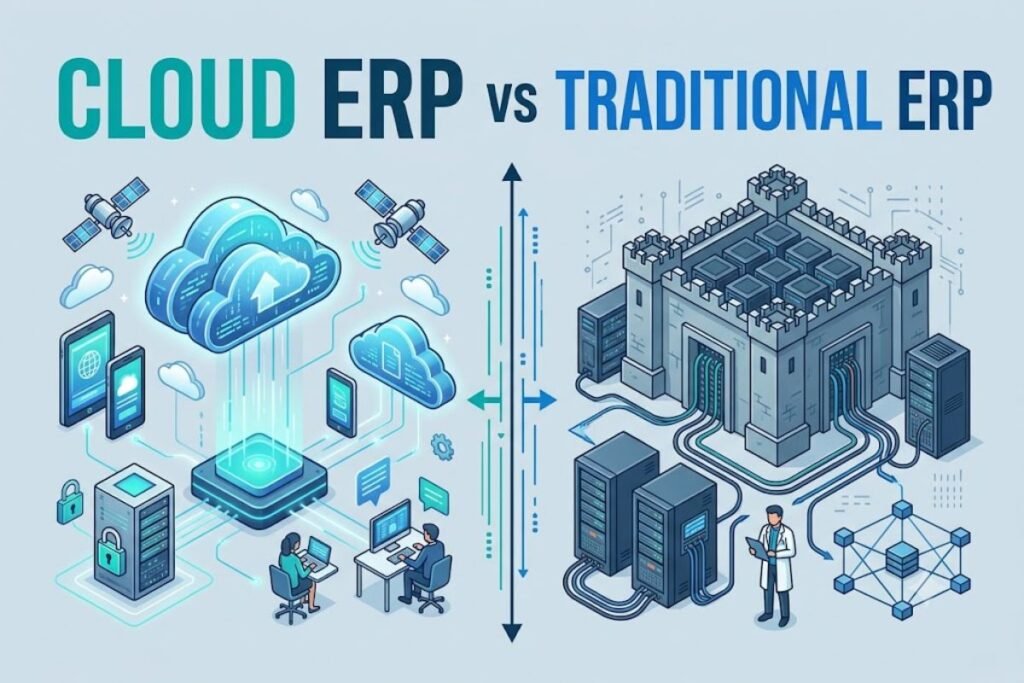
Many organizations compare traditional ERP with cloud ERP before investing in new technology.
Deployment
Traditional ERP operates on company-owned servers. Cloud ERP runs on secure internet-based infrastructure managed by the software provider.
Cost
Traditional ERP often requires:
- Server purchases
- Software licenses
- Maintenance contracts
- Infrastructure upgrades
Cloud ERP usually operates through monthly or annual subscriptions, reducing upfront investment.
Maintenance
With traditional ERP, internal IT teams manage:
- Updates
- Security patches
- Server maintenance
- Backup systems
Cloud providers perform these tasks automatically.
Accessibility
Traditional ERP often limits access to office networks. Cloud ERP supports secure access from nearly anywhere with an internet connection.
Scalability
Expanding traditional ERP requires purchasing additional hardware. Cloud ERP allows businesses to increase resources almost instantly.
ERP Implementation Process
Successful ERP and Cloud Computing projects require careful planning. Organizations that rush implementation often experience delays and higher costs. A structured implementation process reduces risk.
Step 1: Business Requirement Analysis
Before selecting software, companies should identify:
- Business goals
- Current challenges
- Required modules
- Future growth plans
Understanding business needs ensures the ERP solution supports long-term objectives.
Step 2: Software Selection
Businesses should compare ERP vendors based on:
- Features
- Pricing
- Security
- Industry expertise
- Customer support
- Scalability
Selecting the most suitable platform is a critical decision that directly influences the success of the entire project.
Step 3: Data Migration
Existing business data must be transferred carefully.
This includes:
- Customer information
- Financial records
- Inventory data
- Employee records
- Supplier information
Accurate migration prevents operational disruptions.
Step 4: Employee Training
Technology succeeds only when employees know how to use it.
Training should include:
- Department-specific workflows
- Reporting tools
- Security practices
- Daily operations
Well-trained employees adopt new systems more quickly.
Step 5: Go-Live and Monitoring
After deployment, organizations should monitor:
- System performance
- User adoption
- Business processes
- Security
- Customer feedback
Continuous improvement ensures long-term success.
Industries Using ERP and Cloud Computing
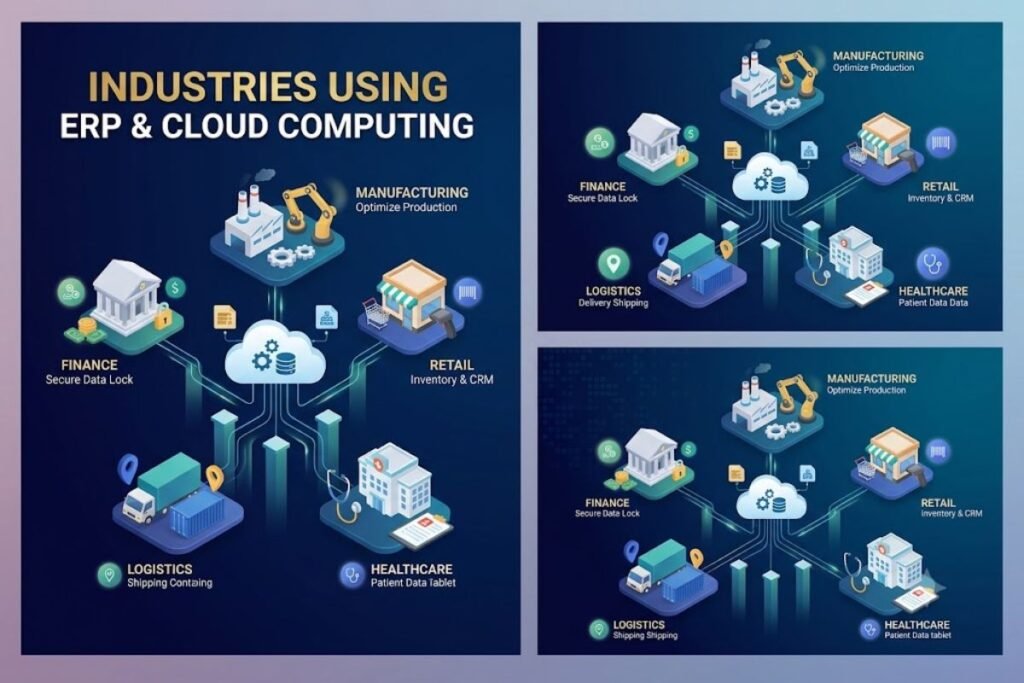
Almost every industry now benefits from ERP and Cloud Computing.
Manufacturing
Manufacturers use ERP to:
- Track production
- Manage suppliers
- Monitor inventory
- Improve quality control
Retail
Retail businesses rely on ERP for:
- Inventory management
- Online sales
- Customer loyalty
- Order fulfillment
Healthcare
Hospitals and clinics manage:
- Patient records
- Billing
- Staff scheduling
- Medical inventory
through integrated ERP solutions.
Education
Educational institutions increasingly adopt cloud-based ERP systems for:
- Student enrollment
- Financial management
- Human resources
- Learning administration
Many educators ask, how does cloud computing power ed-tech?
The answer is simple: cloud platforms allow schools, universities, and online learning providers to deliver educational resources, virtual classrooms, collaboration tools, and learning management systems through the internet. This improves accessibility, supports remote learning, and enables institutions to scale services without investing heavily in local infrastructure.
Hospitality and Restaurants
Hotels and restaurants use ERP software to manage:
- Reservations
- Inventory
- Procurement
- Payroll
- Customer service
Businesses in this sector can also explore restaurent.net for restaurant management insights and beachnear.net for travel and hospitality ideas that complement digital transformation strategies.
Common Challenges During ERP Adoption
Although ERP and Cloud Computing provide many benefits, organizations should prepare for potential challenges.
Resistance to Change
Employees may hesitate to adopt new systems. Clear communication and effective training reduce resistance.
Data Quality Issues
Incorrect or duplicate data can create reporting problems. Businesses should clean and validate data before migration.
Budget Management
Unexpected customization or implementation delays may increase project costs. Detailed planning helps organizations stay within budget.
Integration Complexity
ERP software often connects with:
- CRM systems
- E-commerce platforms
- Payment gateways
- Business intelligence tools
Careful integration planning ensures smooth communication between applications.
User Adoption
Even the best ERP software cannot deliver value if employees avoid using it. Organizations should provide continuous support and encourage user feedback to improve adoption.
Best Practices for Successful ERP and Cloud Computing Adoption
Organizations can maximize the value of ERP and Cloud Computing by following proven best practices.
- Define clear business objectives before implementation.
- Select an ERP solution that aligns with your industry’s needs.
- Involve stakeholders from every department early in the project.
- Keep business processes as simple and standardized as possible.
- Prioritize data accuracy before migration.
- Invest in comprehensive employee training.
- Monitor key performance indicators (KPIs) after deployment.
- Regularly review system performance and optimize workflows.
- Stay informed about cloud computing updates today and cloud computing news to take advantage of new features and innovations.
These practices help businesses achieve a faster return on investment while ensuring the ERP system continues to support future growth.
Cloud Computing Security in ERP Systems
One of the biggest concerns businesses have before moving to the cloud is cloud computing security. Organizations store valuable information such as financial records, customer data, employee details, contracts, and intellectual property inside their ERP systems. Safeguarding sensitive business data is crucial for maintaining uninterrupted operations and strengthening customer trust. Fortunately, modern cloud ERP providers invest heavily in advanced security technologies that many small and medium-sized businesses would find difficult or expensive to implement on their own.
Key Security Features of Cloud ERP
A secure cloud ERP platform typically includes:
- Data encryption during storage and transmission
- Multi-factor authentication (MFA)
- Role-based access control (RBAC)
- Continuous security monitoring
- Automated backups
- Disaster recovery solutions
- Intrusion detection systems
- Security event logging
- Compliance with international security standards
These measures help reduce the risk of cyberattacks, unauthorized access, and accidental data loss.
Data Encryption
Encryption converts sensitive business information into unreadable code that can only be accessed with the correct encryption key.
This protects:
- Customer records
- Financial transactions
- Payroll information
- Business reports
- Contracts
Strong encryption safeguards sensitive information, ensuring that intercepted data cannot be easily viewed or exploited.
Access Management
Not every employee needs access to every part of an ERP system. Cloud ERP platforms allow organizations to assign permissions based on job roles.
For example:
- HR staff access employee records.
- Finance teams manage accounting.
- Sales teams view customer information.
- Warehouse staff update inventory.
Role-based access improves both security and operational efficiency.
Disaster Recovery
Unforeseen events, including hardware malfunctions, cyber threats, and natural disasters, can interrupt normal business operations. A reliable cloud ERP solution minimizes downtime by providing automated backups, disaster recovery capabilities, and rapid data restoration. Cloud ERP providers maintain backup systems in multiple data centers, allowing businesses to restore operations quickly if problems occur. This level of resilience is one of the major benefits of cloud computing.
What Is AI in Cloud Computing?
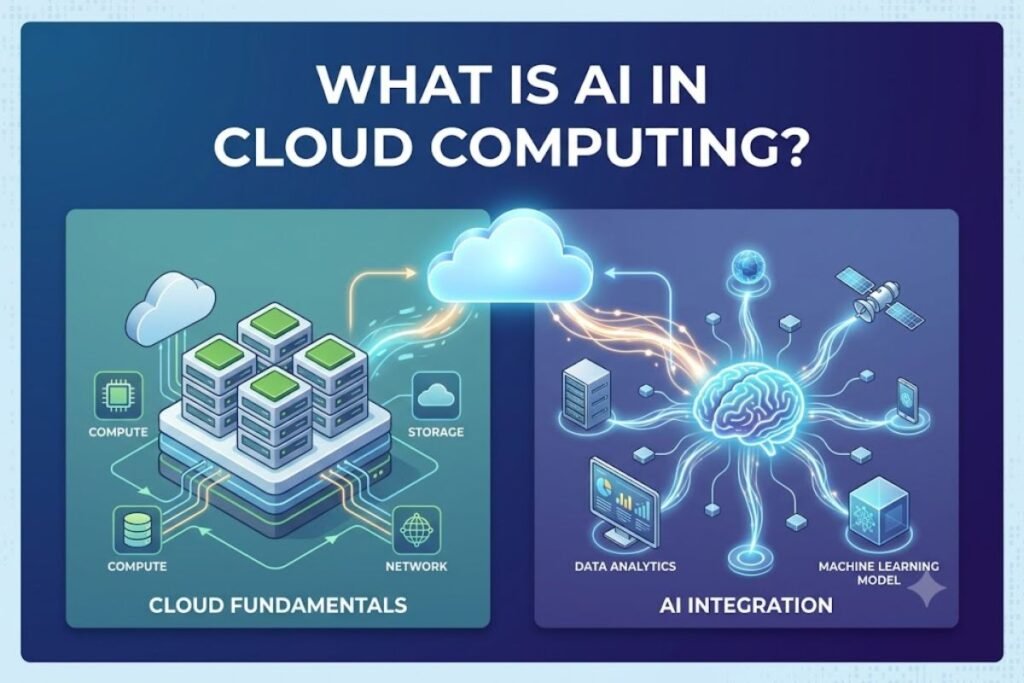
Many business leaders now ask, what is AI in cloud computing?
Artificial intelligence (AI) in cloud computing refers to the use of machine learning, predictive analytics, automation, and intelligent algorithms delivered through cloud platforms. Instead of purchasing expensive AI infrastructure, organizations can access AI-powered tools directly from cloud providers. When AI is integrated with ERP software, businesses gain smarter automation and deeper insights from their data.
AI Features in Cloud ERP
Modern cloud ERP systems increasingly include AI capabilities such as:
- Predictive demand forecasting
- Automated invoice processing
- Intelligent inventory optimization
- Fraud detection
- Financial forecasting
- Customer behavior analysis
- Smart chatbots
- Document recognition
- Workflow automation
These features reduce manual work and improve decision-making.
Predictive Analytics
AI analyzes historical business data to forecast future trends.
For example, an ERP system can predict:
- Seasonal demand
- Inventory shortages
- Sales growth
- Equipment maintenance needs
- Cash flow trends
Predictive insights help businesses prepare for future opportunities and risks.
Intelligent Automation
Instead of manually approving routine tasks, AI can automate processes such as:
- Purchase approvals
- Expense validation
- Invoice matching
- Customer service requests
- Inventory replenishment
Automation improves productivity while reducing human error.
ERP and Cloud Computing Trends
Technology continues to evolve rapidly, and several ERP and cloud computing trends are shaping the future of enterprise software.
AI-Driven ERP Systems
Modern ERP platforms increasingly integrate artificial intelligence to automate business processes, improve data analysis, and support faster, more informed decision-making.
Businesses increasingly rely on AI to:
- Improve forecasting
- Detect anomalies
- Automate workflows
- Generate business recommendations
Low-Code and No-Code Development
Organizations want to customize ERP systems without extensive programming. Low-code platforms allow users to create workflows, dashboards, and reports using visual tools instead of traditional coding. This accelerates digital transformation projects.
Industry-Specific ERP Solutions
ERP vendors now offer specialized solutions for industries such as:
- Healthcare
- Retail
- Manufacturing
- Construction
- Education
- Hospitality
- Logistics
These solutions include prebuilt workflows that reduce implementation time.
Advanced Analytics
Businesses expect ERP software to provide actionable insights rather than just storing information.
Modern dashboards include:
- Interactive charts
- KPI tracking
- Predictive analytics
- Real-time reporting
- Executive dashboards
This helps leaders make informed decisions faster.
Sustainable Cloud Operations
Many organizations are prioritizing environmental responsibility.
Cloud providers are investing in:
- Energy-efficient data centers
- Renewable energy sources
- Carbon reduction initiatives
- Intelligent resource optimization
Sustainability is becoming an important factor when selecting cloud services.
Edge Computing vs Cloud Computing
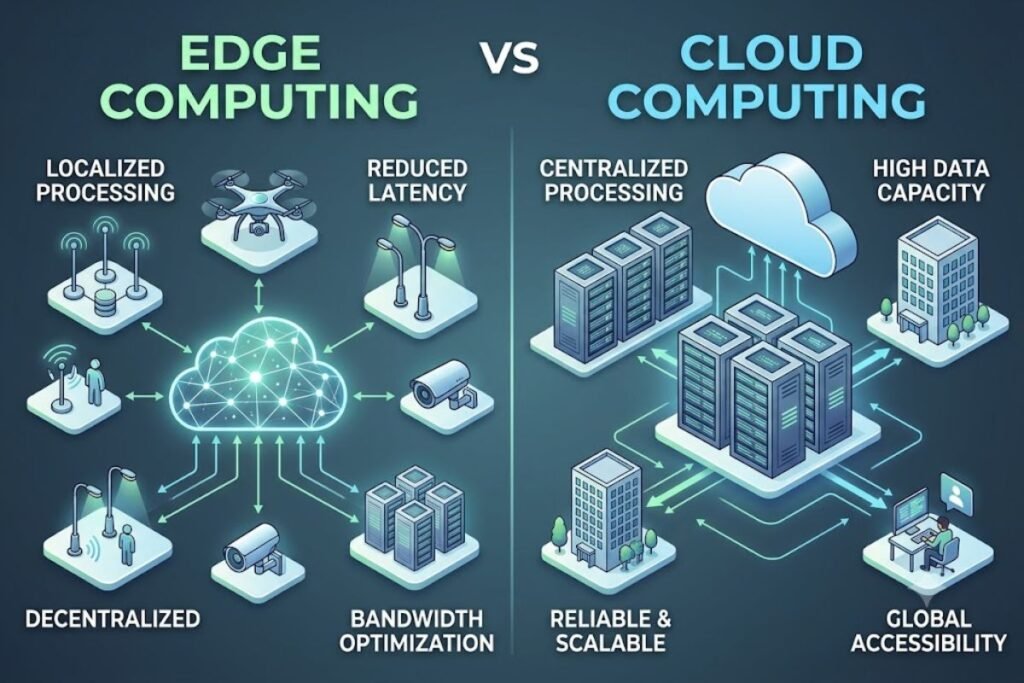
Another growing topic is edge computing vs cloud computing. Although both technologies support digital transformation, they serve different purposes.
Cloud Computing
Cloud computing processes and stores information in centralized data centers that users access over the internet.
It works well for:
- ERP software
- Data storage
- Business analytics
- Collaboration tools
- Customer management
Edge Computing
Edge computing processes data at or near the location where it is generated, enabling faster response times, lower latency, and improved performance for real-time applications. Instead of sending all data to the cloud, some processing happens on local devices or nearby servers. This reduces latency and improves response times.
Key Differences
| Cloud Computing | Edge Computing |
| Centralized processing | Local processing |
| Internet-based | Device or local server-based |
| Excellent for enterprise applications | Excellent for real-time processing |
| High scalability | Faster local response |
| Supports cloud ERP | Supports IoT and smart devices |
Instead of viewing edge computing and cloud computing as competing technologies, many organizations combine both to build a flexible, efficient, and high-performing IT infrastructure.
Cloud Computing Technology and Digital Transformation
Modern cloud computing technology is transforming nearly every aspect of business.
Organizations use cloud platforms to support:
- Digital workplaces
- Business intelligence
- Customer relationship management
- Enterprise resource planning
- Artificial intelligence
- Internet of Things (IoT)
- Data analytics
- Cybersecurity
Cloud technology provides the flexibility businesses need to innovate quickly.
Hybrid Work Environments
Cloud ERP enables employees to work securely from almost anywhere.
This flexibility supports:
- Remote employees
- Hybrid workplaces
- International teams
- Mobile sales staff
Organizations can continue operations even when teams are geographically distributed.
Business Continuity
Cloud infrastructure helps companies maintain operations during unexpected events. Automatic backups, disaster recovery, and geographically distributed data centers reduce downtime and improve resilience.
Innovation Through Integration
Modern ERP systems integrate with many business applications, including:
- E-commerce platforms
- Payment gateways
- CRM software
- Business intelligence tools
- Marketing automation
- Collaboration platforms
Integration creates a connected digital ecosystem that improves productivity.
Cloud Computing News and Industry Updates
Technology changes rapidly, making it important for businesses to stay informed about cloud computing news, cloud computing news today, and cloud computing updates today.
Following trusted technology publications and vendor announcements helps organizations:
- Discover new ERP features
- Learn about cybersecurity updates
- Monitor AI innovations
- Understand compliance changes
- Compare cloud service providers
- Identify emerging business opportunities
Regularly reviewing industry developments allows businesses to adopt new capabilities before competitors. For the latest technology articles, cloud innovations, software reviews, and digital transformation insights, readers can explore techallworld.com and techhatoz.com, which publish resources for businesses, professionals, and technology enthusiasts worldwide.
Choosing the Right Cloud ERP Solution
Selecting the right ERP platform is a long-term investment. Businesses should evaluate potential solutions carefully before making a decision.
Define Business Goals
Start by identifying:
- Current operational challenges
- Future growth plans
- Required ERP modules
- Industry-specific needs
Clear objectives make it easier to compare vendors.
Evaluate Scalability
Select a solution that can scale seamlessly as your business expands.
A scalable cloud ERP platform should support:
- Additional users
- Multiple locations
- New business units
- International operations
- Increased transaction volumes
Assess Security and Compliance
Security should never be an afterthought.
Look for providers that offer:
- Strong encryption
- Multi-factor authentication
- Regular security audits
- Compliance certifications
- Reliable disaster recovery
Review Vendor Support
Reliable customer support is essential for long-term success.
Evaluate:
- Training resources
- Technical support availability
- Documentation
- User communities
- Update frequency
Strong vendor support reduces implementation risks and improves user adoption. Before selecting an ERP platform, it’s helpful to compare technology trends and software reviews from trusted sources. TechH AtoZ offers practical articles covering cloud solutions, business software, and digital transformation strategies for modern organizations.
Measuring the Success of ERP and Cloud Computing
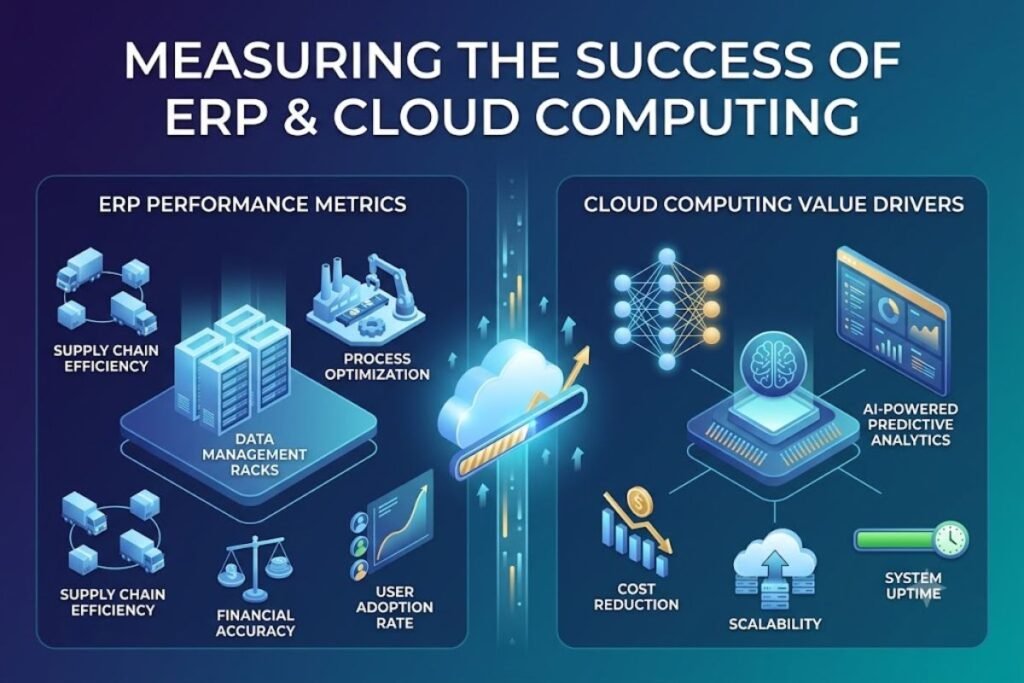
After implementation, organizations should monitor key performance indicators (KPIs) to measure the value of ERP and Cloud Computing.
Common KPIs include:
- Reduced operational costs
- Faster order processing
- Improved inventory accuracy
- Shorter financial closing cycles
- Increased employee productivity
- Higher customer satisfaction
- Reduced system downtime
- Better decision-making through real-time reporting
- Faster return on investment (ROI)
Regular performance reviews help businesses identify areas for optimization and ensure that the ERP system continues to support strategic goals.
Real-World Examples of ERP and Cloud Computing
Real-world examples show how organizations use ERP and cloud computing to streamline operations, improve productivity, and achieve better business outcomes, making these technologies easier to understand and apply. Companies across industries rely on cloud ERP solutions to improve efficiency, reduce costs, and deliver better customer experiences.
Manufacturing
Manufacturers use ERP software to manage production schedules, monitor inventory, purchase raw materials, and track product quality. With cloud ERP, production managers can monitor factory operations in real time from any location. Automated reports help reduce waste, improve quality, and increase productivity.
Retail and E-Commerce
Retailers manage thousands of products across physical stores and online marketplaces.
A cloud-based ERP system helps businesses:
- Synchronize inventory
- Process online orders
- Manage suppliers
- Track customer purchases
- Analyze sales trends
Real-time visibility reduces stock shortages and improves customer satisfaction.
Healthcare
Hospitals and healthcare organizations use ERP systems to manage:
- Medical inventory
- Employee scheduling
- Procurement
- Billing
- Financial reporting
Cloud ERP improves collaboration while maintaining strong cloud computing security practices for sensitive patient and financial data.
Education
Educational institutions benefit from cloud computing by managing admissions, payroll, online learning platforms, student records, and financial operations. Schools and universities also demonstrate how does cloud computing power ed-tech? By providing cloud-based learning management systems, virtual classrooms, digital collaboration tools, and online assessments, institutions can offer flexible and accessible education to learners worldwide.
Hospitality and Tourism
Hotels, resorts, restaurants, and travel companies use ERP systems to improve reservations, inventory management, accounting, procurement, and customer service. Businesses in these sectors can also explore restaurent.net for restaurant management insights and beachnear.net for travel inspiration, hospitality ideas, and destination-focused business resources.
Common Mistakes to Avoid During ERP Implementation
A successful ERP and Cloud Computing deployment requires thorough planning, because overlooking crucial implementation stages can result in project failure. Avoiding common mistakes increases the likelihood of a successful deployment.
Choosing Software Based Only on Price
Selecting the lowest-cost option does not always deliver the greatest value or long-term business benefits. Consider functionality, scalability, security, and vendor support alongside cost.
Ignoring Employee Training
Employees are the main users of an ERP system, making proper training and user adoption essential for successful implementation. Without proper training, businesses may experience low adoption rates and reduced productivity.
Poor Data Preparation
Migrating outdated or inaccurate information into a new ERP system can lead to reporting errors and operational issues. Clean and validate data before migration.
Over-Customization
Excessive customization can increase costs, delay implementation, and complicate future software updates. Whenever possible, use standard ERP features and only customize where there is clear business value.
Lack of Executive Support
ERP implementation requires commitment from leadership. Executive sponsorship helps allocate resources, resolve challenges, and encourage organization-wide adoption.
The Future of ERP and Cloud Computing
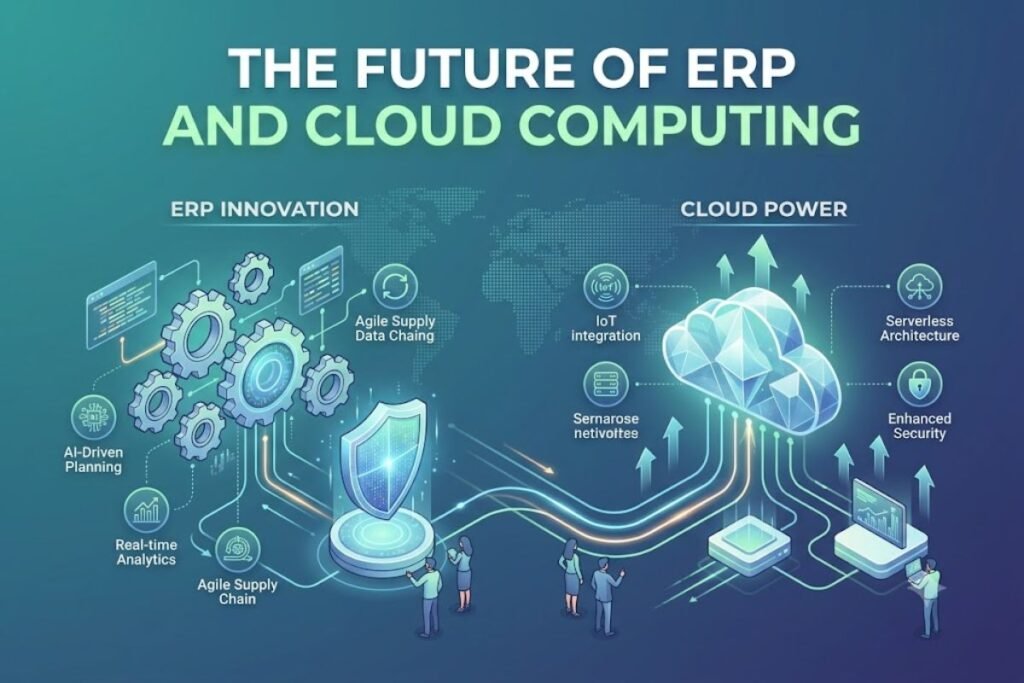
The future of ERP and Cloud Computing is driven by continuous innovation. Businesses increasingly expect ERP platforms to deliver not only operational management but also intelligent insights, automation, and seamless integration with emerging technologies.
Future developments are expected to include:
- More AI-powered decision support
- Greater automation across business processes
- Enhanced predictive analytics
- Improved cybersecurity capabilities
- Better mobile accessibility
- Expanded Internet of Things (IoT) integration
- Sustainability-focused cloud infrastructure
- Faster deployment through low-code and no-code customization
Organizations that embrace these innovations will be better positioned to adapt to changing markets and maintain a competitive advantage.
Conclusion
ERP and Cloud Computing have fundamentally changed the way organizations operate in today’s digital economy. Integrating an ERP system with the scalability and flexibility of cloud computing enables businesses to optimize workflows, strengthen team collaboration, lower operational expenses, and make smarter decisions based on real-time data.
Understanding what is ERP, what is an ERP system, what is cloud computing, and the difference between ERP and cloud computing enables business leaders to choose technology solutions that align with their long-term goals.
Modern cloud ERP platforms continue to evolve with artificial intelligence, automation, advanced analytics, and stronger cloud computing security, making them valuable tools for organizations of every size and industry. Whether you operate a startup, a growing business, or a global enterprise, investing in ERP and Cloud Computing can improve efficiency, support innovation, and prepare your organization for the future.
To continue learning about enterprise technology, cloud innovation, software trends, and digital transformation, explore Tech All World and Techh AtoZ. If your business operates in hospitality, food, or tourism, Restaurent.net and Beach Near provide additional resources tailored to those industries.
Final Thoughts
Technology has evolved beyond a supporting role and now serves as a key force behind business strategy and long-term growth. Organizations that successfully implement ERP and Cloud Computing gain a unified platform for managing operations, accessing real-time insights, and responding quickly to market changes.
As cloud services continue to evolve with artificial intelligence, automation, and enhanced security, ERP systems will become even more intelligent, connected, and accessible. Organizations that adopt the right cloud ERP platform today can enhance customer satisfaction, use resources more efficiently, and build a strong foundation for long-term business success.
FAQs
Q:01. What is ERP and Cloud Computing?
Ans: ERP and Cloud Computing combine enterprise resource planning software with cloud-based infrastructure. This allows businesses to manage finance, inventory, HR, sales, and other operations through internet-hosted platforms that are scalable, secure, and accessible from anywhere.
Q:02. What is the difference between ERP and cloud computing?
Ans: The difference between ERP and cloud computing is that ERP is business management software, while cloud computing is the technology that delivers applications and computing resources over the internet. ERP can run either on-premises or in the cloud.
Q:03. What are the benefits of cloud ERP?
Ans: Cloud ERP offers lower infrastructure costs, automatic updates, remote access, real-time reporting, improved scalability, stronger collaboration, simplified maintenance, and enhanced disaster recovery compared with traditional on-premises ERP systems.
Q:04. What is AI in cloud computing?
Ans: What is AI in cloud computing? It refers to artificial intelligence services delivered through cloud platforms. AI enhances ERP systems by enabling predictive analytics, workflow automation, intelligent reporting, fraud detection, and smarter business decision-making.
Q:05. Is cloud ERP secure?
Ans: Yes. Leading providers prioritize cloud computing security by using encryption, multi-factor authentication, role-based access control, continuous monitoring, automated backups, and compliance with international security standards to protect business data.
Q:06. Which industries benefit most from ERP and Cloud Computing?
Ans: Almost every industry benefits, including manufacturing, retail, healthcare, education, logistics, finance, hospitality, government, and professional services. Organizations of all sizes can use ERP and Cloud Computing to improve operational efficiency, collaboration, and long-term business growth.



2 Comments